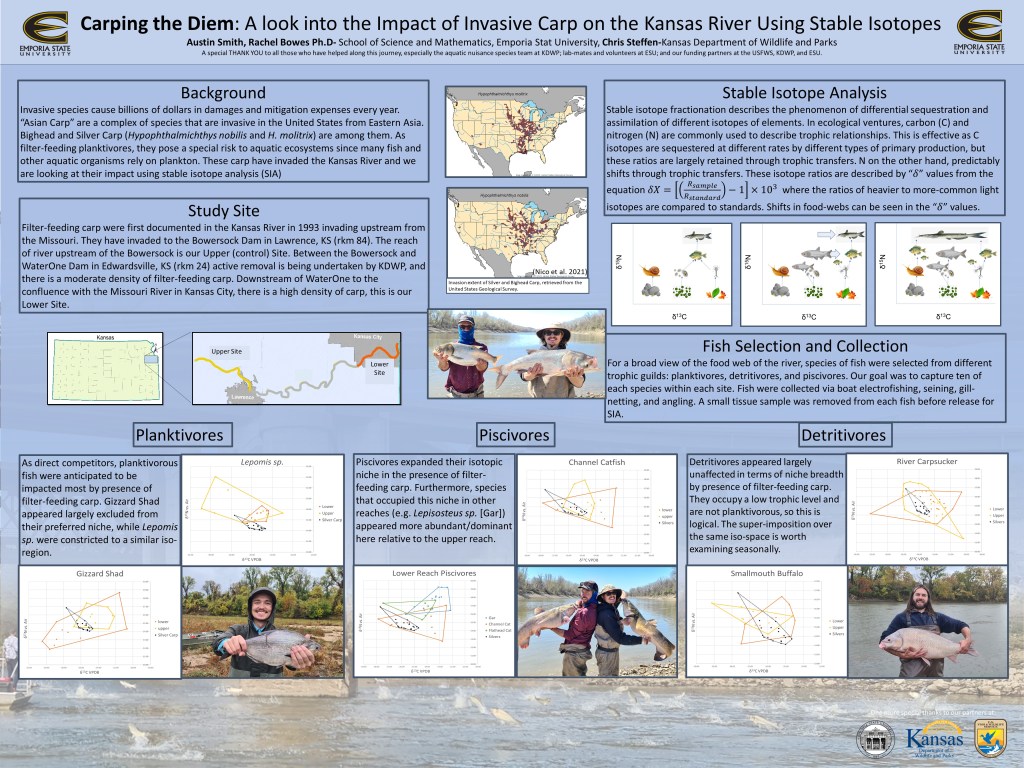
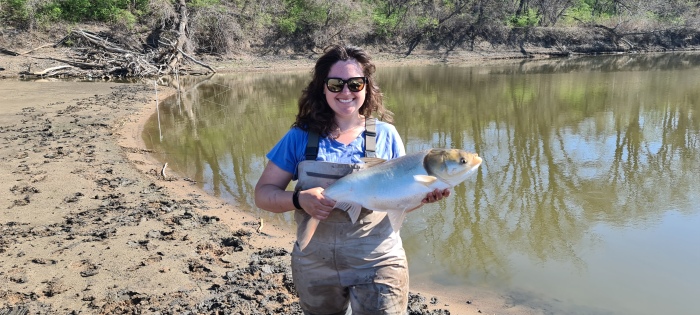
Since the 1970’s invasive carp have expanded throughout much of the Mississippi River basin. Bighead (Hypophthalmichthys nobilis) and Silver (H. molitrix) carp are prolific, filter-feeding fish that drastically reduce plankton where their populations get too dense. This can affect resident fish communities that also rely on planktonic resources. Ecological studies often use the relative abundance of stable carbon (C) and nitrogen (N) isotopes to show trophic relationships and describe food webs. The lower Kansas River has a highly stratified invasion gradient of Hypophthalmichthys carp due to impoundments with high-density, low-density, and absent* reaches. We collected tissue from ten species found across this density gradient to demonstrate the carps’ effect on resident communities using bulk C and N stable isotope samples. The data produced show species-specific shifts in nutrient uptake as well as constriction in overall niche space across the invasion gradient. These shifts demonstrate the trophic cascade these carp created, more clearly elucidating the toll taken on resident fish communities. We provide a forecast for managers contending with future invasions in the sub-basin by demonstrating carp density-dependent effects on the food webs of native fishes.